.rex-hero{padding-top:0 !important;} .pab{background:#ffffff;color:#7a7a7a;font-family:’Roboto’,’Helvetica Neue’,Arial,sans-serif;font-weight:400;line-height:1.6;-webkit-font-smoothing:antialiased;} .pab *{box-sizing:border-box;} .pab .pab-wrap{max-width:1120px;margin:0 auto;padding:clamp(118px,13vw,152px) clamp(16px,4vw,48px) 90px;} .pab .pab-kicker{font-size:12px;letter-spacing:.26em;text-transform:uppercase;color:#cb2026;font-weight:500;margin:0 0 14px;} .pab .pab-h1{font-weight:700;font-size:clamp(32px,5.6vw,58px);line-height:1.03;letter-spacing:-.02em;margin:0;color:#1e1e1e;max-width:16ch;} .pab .pab-videowrap{position:relative;width:100%;aspect-ratio:16/9;background:#111;margin-top:38px;border-radius:4px;overflow:hidden;} .pab .pab-videowrap iframe{position:absolute;inset:0;width:100%;height:100%;border:0;} .pab .pab-chapters{display:grid;grid-template-columns:repeat(5,1fr);gap:1px;background:#e7e7e7;border:1px solid #e7e7e7;border-top:0;} .pab .pab-chap{background:#fafafa;border:0;cursor:pointer;padding:14px 10px;font-family:inherit;font-size:12.5px;font-weight:500;letter-spacing:.02em;color:#6a6a6a;text-align:center;transition:background .25s,color .25s;position:relative;} .pab .pab-chap::before{content:””;position:absolute;top:-1px;left:0;right:0;height:3px;background:#cb2026;transform:scaleX(0);transform-origin:left;transition:transform .3s;} .pab .pab-chap:hover{background:#fff;color:#1e1e1e;} .pab .pab-chap.is-active{background:#fff;color:#cb2026;} .pab .pab-chap.is-active::before{transform:scaleX(1);} .pab .pab-full{display:inline-flex;align-items:center;gap:9px;margin-top:18px;padding:12px 20px;background:#cb2026;color:#fff;border:0;border-radius:8px;cursor:pointer;font-family:inherit;font-size:14px;font-weight:600;letter-spacing:.02em;} .pab .pab-sec{margin-top:74px;} .pab .pab-head{position:relative;font-weight:600;font-size:clamp(19px,2.3vw,24px);letter-spacing:-.01em;color:#1e1e1e;margin:0 0 6px;padding-top:18px;border-top:1px solid #e7e7e7;} .pab .pab-head::before{content:””;position:absolute;top:-1px;left:0;width:46px;height:3px;background:#cb2026;} .pab .pab-prose{margin-top:26px;max-width:none;column-width:400px;column-gap:50px;} .pab .pab-prose p{font-size:clamp(15px,1.7vw,16.5px);font-weight:300;line-height:1.82;color:#3a3a3a;margin:0 0 20px;text-align:justify;-webkit-hyphens:auto;hyphens:auto;break-inside:avoid;} .pab .pab-prose em{font-style:italic;color:#1e1e1e;} .pab .pab-prose strong{font-weight:600;color:#cb2026;} .pab .pab-circle{display:block;width:100%;max-width:600px;height:auto;margin:44px auto 0;} .pab .pab-splogos{margin-top:26px;display:grid;grid-template-columns:repeat(auto-fill,minmax(168px,1fr));gap:1px;background:#e7e7e7;border:1px solid #e7e7e7;} .pab .pab-spcell{background:#fff;aspect-ratio:3/2;display:flex;align-items:center;justify-content:center;padding:24px 20px;text-align:center;} .pab .pab-spcell img{max-width:100%;max-height:60px;object-fit:contain;} .pab .pab-spcell .vtext{font-size:11px;font-weight:600;letter-spacing:.06em;color:#3a3a3a;line-height:1.5;} .pab .pab-names{margin-top:26px;display:grid;grid-template-columns:repeat(auto-fill,minmax(200px,1fr));gap:1px;background:#e7e7e7;border:1px solid #e7e7e7;} .pab .pab-name{background:#fff;padding:16px 20px;display:flex;align-items:center;gap:11px;font-size:14.5px;color:#1e1e1e;} .pab .pab-name::before{content:””;width:6px;height:6px;border-radius:50%;background:#cb2026;flex:none;} @media (max-width:640px){.pab .pab-chapters{grid-template-columns:repeat(2,1fr);}}

Pan-African Biennale

Pan-African Biennale 2026

The Circle of Continuity

Curatorial Text

Across Africa, vernacular knowledge systems are often described as fragile, temporary, or belonging to the past. Yet what has endured across generations reveals another reality: an intelligence embedded in landscape, material, ritual, memory, and collective life. It emerges from an accumulated wisdom — an architecture of care, shaped through centuries of adaptation to climate, ecology, and community.

Selected to represent Ethiopia in the inaugural Pan-African Biennale, RAAS Architects presents The Circle of Continuity as an exploration of Vernacular Intelligence: not as static heritage, but as a living methodology for imagining the future. Rather than preserving tradition as artifact, the exhibition explores how indigenous ways of building, inhabiting, and understanding place continue to inform contemporary practice. Technology is positioned not as a replacement for ancestral knowledge, but as its extension — a means to document, reinterpret, and carry it forward.

The exhibition takes the form of a dismantlable and reconfigurable installation, drawing upon Ethiopian craft traditions and vernacular construction knowledge. Handcrafted leather, stitching, and modular construction create a spatial archive that can be assembled, disassembled, and adapted to different contexts. Its flexibility reflects the resilience of vernacular systems, where architecture evolves through movement, repair, reuse, and collective participation.

The installation is complemented by visual narratives documenting Ethiopia’s vernacular landscapes, building traditions, and contemporary interpretations. Through photographs, sketches, and project storyboards, these studies reveal how ancestral spatial intelligence continues to inform climate-responsive, human-centred design.

The exhibition unfolds through five interconnected lenses — Ground, Matter, Body, Ritual, and Memory — forming an evolving cycle through which architecture is continually renewed.

It begins with Ground. Before architecture, there is landscape. The earth is the first architect, shaping settlement through topography, climate, water, and ecology. Across Ethiopia, architecture emerges from an intimate reading of place.

From Ground emerges Matter. Earth, stone, timber, bamboo, water, and reclaimed materials are more than construction resources; they are repositories of knowledge shaped by climate, craft, and time. Matter carries the memory of place while offering new possibilities for contemporary expression.

Architecture becomes meaningful through the Body. Buildings exist because of people. The body experiences movement, light, healing, gathering, work, and celebration. Through the body, architecture becomes an act of care, shaping spaces that nurture dignity, wellbeing, and everyday life.

Ritual transforms space into place. Daily acts of gathering, worship, making, and celebration give architecture meaning beyond its physical form. Buildings do not perform these rituals; they provide the setting in which culture is continually practiced and renewed.

Finally, Memory binds the cycle together. Memory is not nostalgia but accumulated knowledge. Ecological knowledge, material traditions, construction techniques, and cultural practices are continually translated rather than replicated, allowing each generation to build upon the last.

Together, these five lenses form a continuous cycle. Ground informs Matter; Matter is shaped by the Body; the Body gives rise to Ritual; Ritual becomes Memory; and Memory continually reshapes our relationship with Ground. The circle never closes — it evolves as each generation reinterprets inherited wisdom, carrying knowledge forward through new places, new materials, and new ways of building.

The Circle of Continuity proposes vernacular intelligence not as an architectural style, but as a living system of knowledge. What we inherit is not simply a collection of forms — we inherit ways of seeing, making, belonging, and caring.

In that continuity, ancestral intelligence remains alive, connecting vernacular knowledge with contemporary architectural practice.
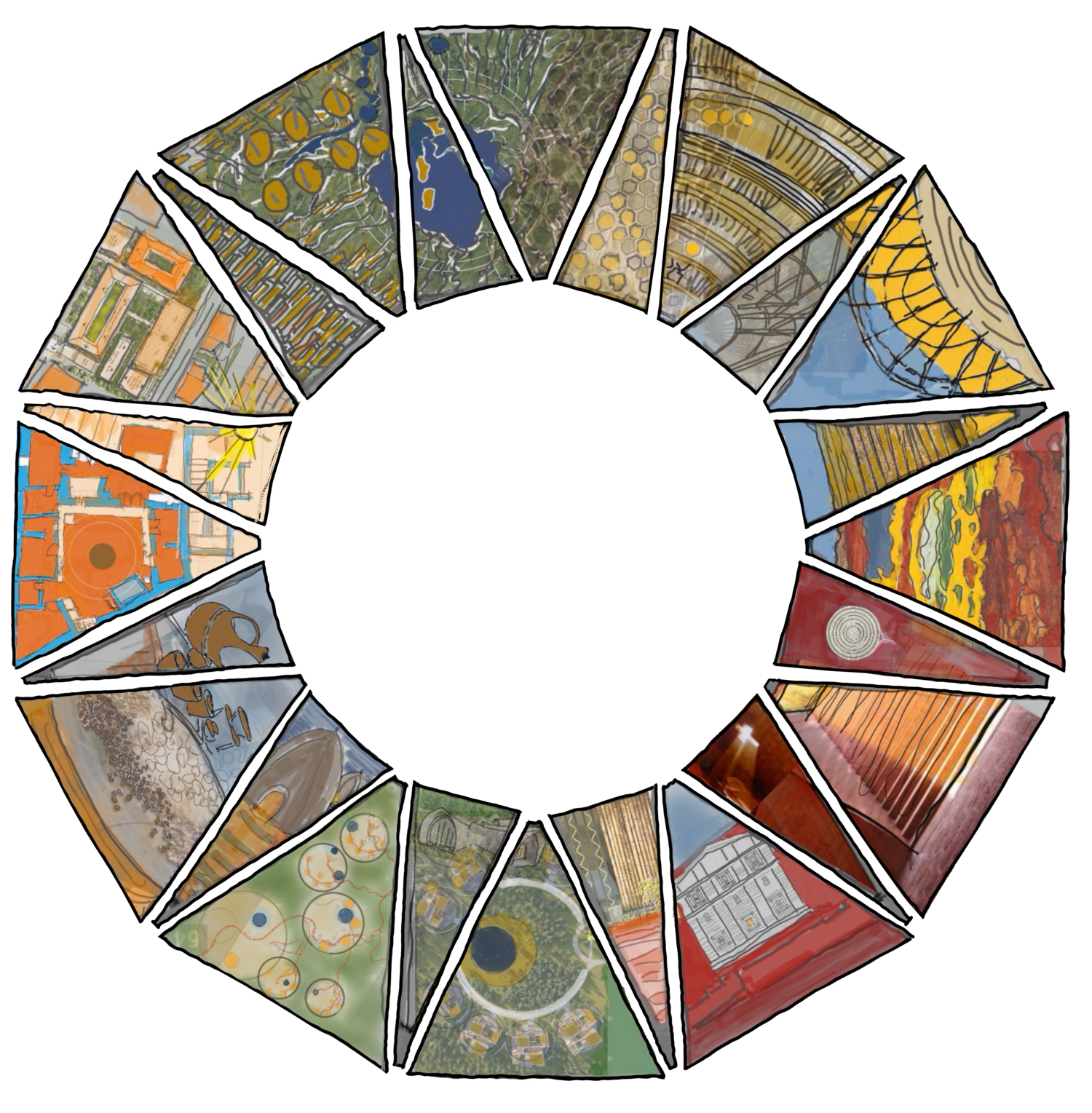

The Circle of Continuity

Sponsors

ELMI Construction
Varnero
Mafer
MultiChoice Ethiopia
Equinox
Symbio Project & Construction Management

Collaborators

Rahel Shawl
Seid Abdu
Gideon Debebe
Abrham Fantu
Biniyam Sahilu
Abigail Debebe
Yeabsira Yared
Kidus Assefa
Yohannes Girma
Biniam Gizaw
Haile Alemseged
Nicholas Simwichi
Moges Hailemariam
Abate Damte (Kora Images)
Gedion Kifle
Powered byInerNett
(function(){var VID=”4ByVH-yXT7g”;var C={“1″:14,”2″:63,”3″:105,”4″:157,”5″:207,”full”:0};window.pabLoad=function(ch,auto){var s=C.hasOwnProperty(ch)?C[ch]:0;var src=”https://www.youtube.com/embed/”+VID+”?rel=0&start=”+s+(auto?”&autoplay=1″:””);var f=document.getElementById(“pab-frame”);if(f)f.src=src;document.querySelectorAll(“.pab-chap”).forEach(function(b){b.classList.toggle(“is-active”,b.getAttribute(“data-ch”)===ch);});try{history.replaceState(null,””,”?ch=”+ch);}catch(e){}};var p=new URLSearchParams(location.search).get(“ch”);if(p&&C.hasOwnProperty(p)){pabLoad(p,true);var v=document.querySelector(“.pab-videowrap”);if(v){setTimeout(function(){v.scrollIntoView({behavior:”smooth”,block:”center”});},350);}}})();